Cages, mice, breeding and genotypes in one place that updates live for the whole lab, works on the phone
you take into the vivarium, and reminds you when litters need weaning and mice need genotyping.
No card needed. Import your existing workbook in minutes.
Spreadsheets weren’t built for colonies
Three copies of the sheet
People overwrite each other, and the copy at the rack is out of date.
One colony that updates live for everyone in the lab.
Dates that slip
Litters weaned late, pups not genotyped in time, males left in breeding cages too long.
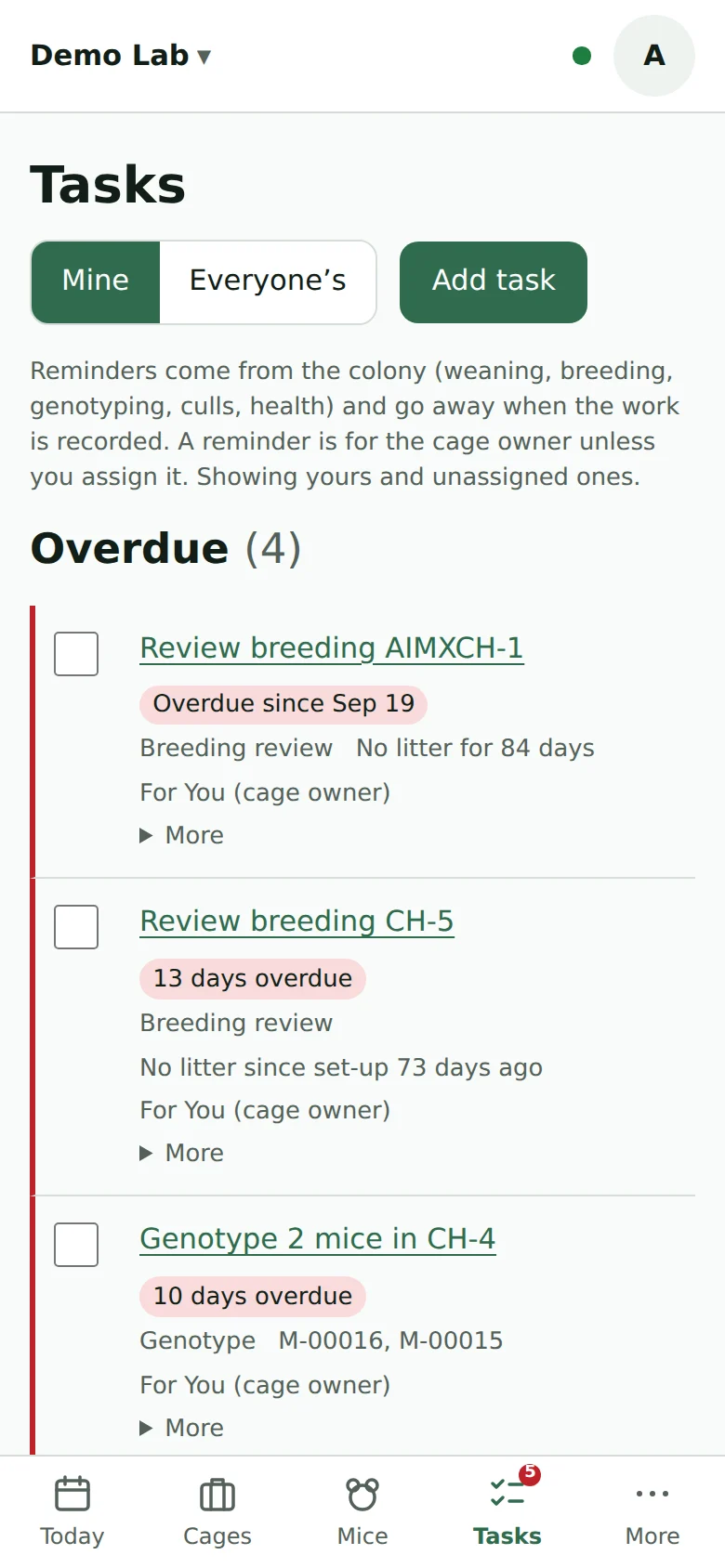
Reminders worked out from your data, on your phone and in a daily email.
Pedigree in a free-text cell
“Female from AIMXCH-6” can’t tell you which pair produces the most het pups.
Parents, litters and breeding history linked for every mouse.
Knowledge that leaves
When a student moves on, so does “which cage is which”.
Every change recorded: who, what and when.
Cage-first, like your sheet
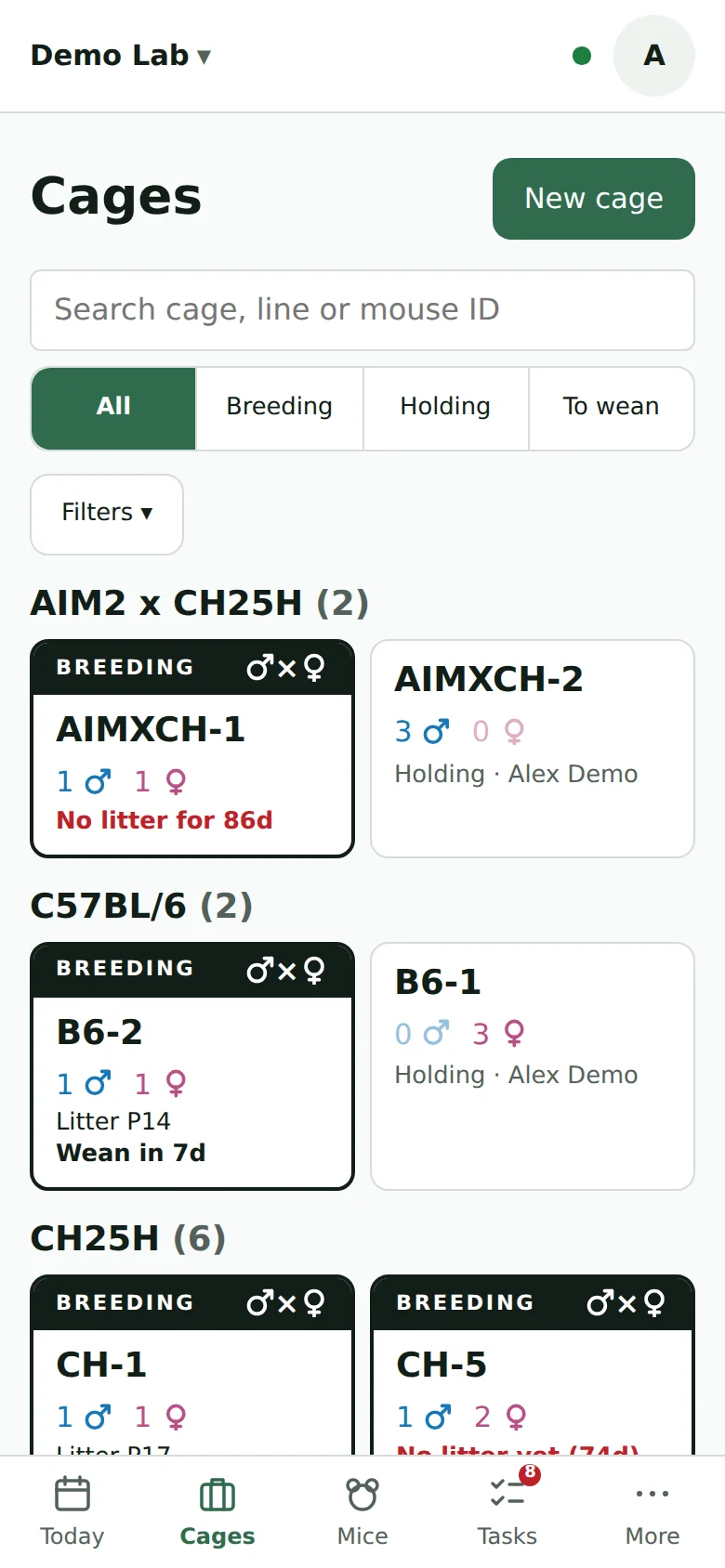
Cages keep the names you already use (CH-14, AIMXCH-7) and the next number for each line. Every
mouse has its ear notch, genotype and a permanent ID, and moving a mouse keeps its whole history.
Breeding cages come first in each line, with the litter’s age and when it’s due to wean, and one tap
shows just the cages to wean. Find any cage or mouse by cage name, line or ID.
Reminders that write themselves
Wean at P21, genotype before weaning, separate the male, check for a litter, daily plug checks for
timed matings, review breeders with no litter in 60 days or over 8 months old, culls, health
re-checks and protocol renewals.
They come from your colony data and clear themselves when the work is recorded. Each one goes to the
cage owner unless you assign it, with a daily email and push notifications if you want them.
Breeding and litters
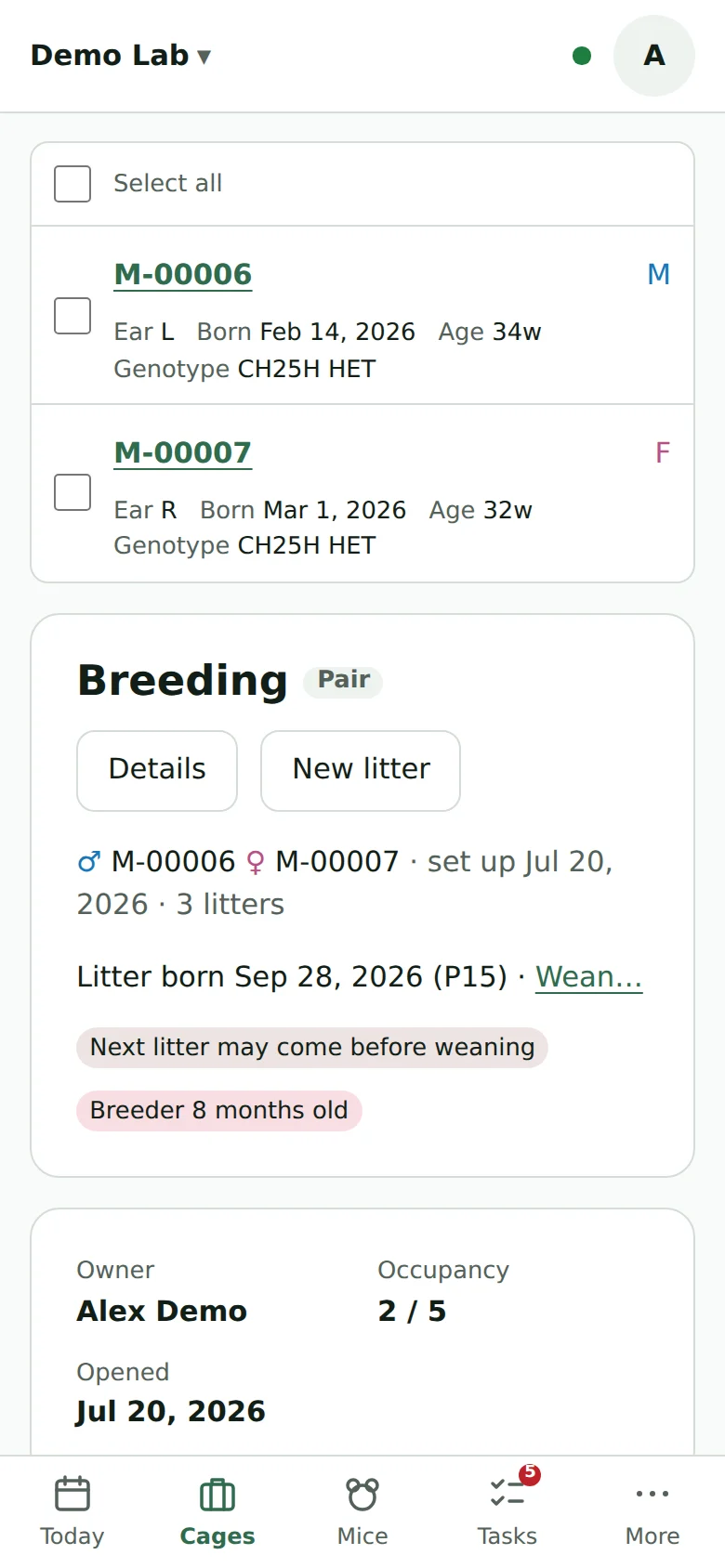
Pairs, trios and harems, with the male staying in or coming out. Each breeding cage keeps its full
litter history, warns when the next litter may arrive before the current one is weaned, and flags
breeders that are getting old.
The wean wizard turns a litter into mice with IDs and ear notches, puts them in new or existing cages
by sex, and can take a genotyping sample from every pup.
Fast at the desk, too
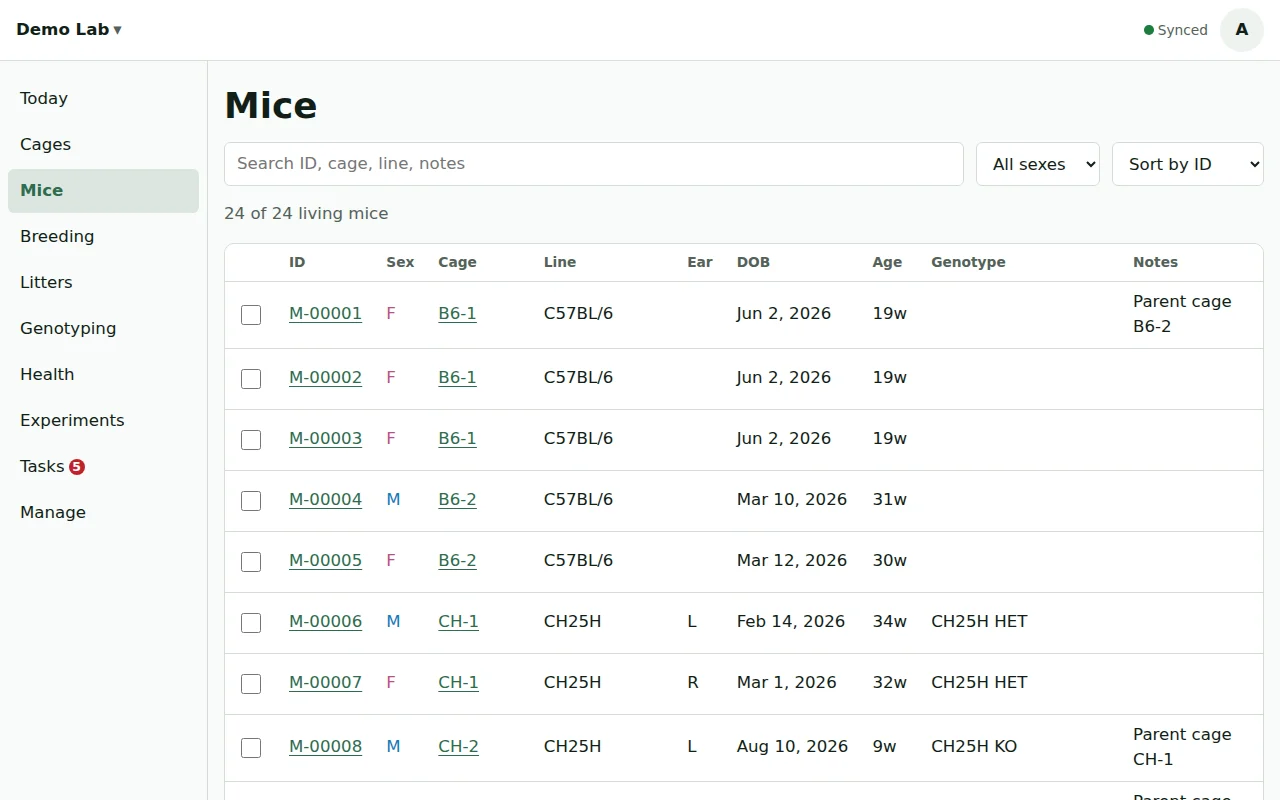
On a computer you get the dense view: the whole colony in a searchable table, filters, selecting
several mice at once, and every change from the rack showing up as it happens.
Genotyping
Take samples, enter calls with the PCR band key on screen, or import a results file from Transnetyx or your own sheet. Calls that can’t come from the parents are flagged.
Health and weights
Weigh a cage at a time. Weight loss is measured against a baseline, with warning and humane-endpoint thresholds you set.
Works at the rack
Install it on your phone’s home screen. Big buttons for gloved hands, push notifications, and it keeps working without signal: changes sync when you’re back in range.
Sac and cull
Sac or cull one mouse or a whole cage in a few taps, with Undo. Mark mice for later and print the list for the animal room; the euthanasia log keeps date, strain, count, purpose and cage, like your sheet.
Cage cards with QR codes
Print cards for your cage holders on Letter or A4, in three sizes, with the mice, genotypes and room for notes. Scanning one opens the cage; someone outside the lab can only ask to join, without seeing whose cage it is.
Shared stock
Share a cage of wild-type or other common stock: anyone in the lab can find “2 females, 6–10 weeks, WT” and take them into their own cage. The owner can approve each request and keep a minimum, and you can see who took how many.
IACUC protocols
Approved numbers per protocol and pain category, with usage meters, warnings at 90% and at the limit, and renewal reminders. New mice and weaned pups pick up the right protocol.
Reports and experiments
Charts of colony size, litter sizes by line and genotypes, plus census, genotypes, breeding performance, protocol usage, per-diem cost estimates and mortality, each as CSV, Excel or a printout, and emailed to your PI or finance office on the 1st of each month. Download any list of mice or cages with a column per gene. Group mice into experiment cohorts by line, sex, age and genotype.
Set up in minutes
A guided tour walks a new lab through the real screens and sets it up on the way: its lines, ID and ear-notch conventions, rooms, protocols, first cages or spreadsheet, and inviting people. Everyone who joins gets a quick tour too. Skip what doesn’t apply and pick it up later from Today.
Your lab, your roles
Managers and workers edit; viewers (a PI, a vet, a collaborator) read for free once a manager approves them. Everyone picks their own look: Classic, Lab notebook or Instrument panel, light or dark, with or without animations.
Secure, and yours to take
Two-step sign-in (labs can require it of everyone) and passkeys, and every change recorded with who, when and the values before and after: search it by mouse, cage, person or date and download it for an inspection. All of your lab’s data as spreadsheets whenever you want it.
Bring your spreadsheet
1
Upload your workbook
The .xlsx or .csv you use today, whatever its columns: say which is which once. Or fill in our template.
2
Review
Tidy line names and answer what was flagged, like a parent cage missing from the sheet or a date that
looks like a typo. Nothing is saved yet.
3
Import
Cages, mice, genotypes and breeding pairs, ready to use on your phone.
Simple pricing
Lab
$20/month
Includes 2 people, then $12/month for each additional
manager or worker. Viewers are free.
Individual
$8/month
One person running their own colony, with every colony feature.
30-day free trial, no card. Annual plans get two months free. Full pricing
Free tools
Mouse wean date calculator: From a birth date or a pairing date: when the litter is due, when to take the male out and when to wean, with a calendar file.
Timed mating calculator (embryonic day): From a plug date: the date of each E-day, the birth and wean windows; or when to set up pairs to have embryos at a stage on a set day. E0.5, E0 or gestation day 1.
Mouse genotype calculator: Expected pup genotypes for up to three genes (knockout, floxed, Cre and other transgenes), and how many pups and litters you need.
Mouse colony spreadsheet template: A free Excel or CSV template for lines, cages, mice, genotypes and breeding, ready to import into CageCard when you want to.
Questions
Can I bring my spreadsheet?
Yes. Upload your .xlsx or .csv as it is: with a row per mouse you match its columns to ours once (we remember them), and a workbook with cage blocks per line is read directly, ear notches, genotypes, parents, room and rack, and your euthanasia log included. Starting from nothing? Fill in our template, with your lines and genes already in it. Either way CageCard points out things to check, like a birth date in the future, before anything is saved.
Do I need a connection in the vivarium?
No. Pages you’ve opened stay readable without signal, and changes you make are kept on the phone and synced when you’re back in range. If someone else changed the same thing meanwhile, you choose which version to keep.
I keep my own mice now. What if I join a lab?
Start with an Individual workspace. When you join a lab, send your records to it: a lab manager matches your lines to theirs and approves, and your cages, mice, genotypes, breeding and litters are copied across with their history.
What happens after the free trial?
Nothing is deleted. The workspace becomes read-only until someone subscribes.
Is it only for mice?
Mice for now. Other species are planned; tell us which one your lab needs.
Where is the data stored?
In the United States, with encrypted connections throughout. Each lab only ever sees its own colony.
Can I get my data out?
Any time. An owner can download everything as spreadsheets, every record with its full history, and can delete the workspace or their own account without asking us.
Try it with your own colony
Import your workbook and see your cages, breeders and what’s due this week.